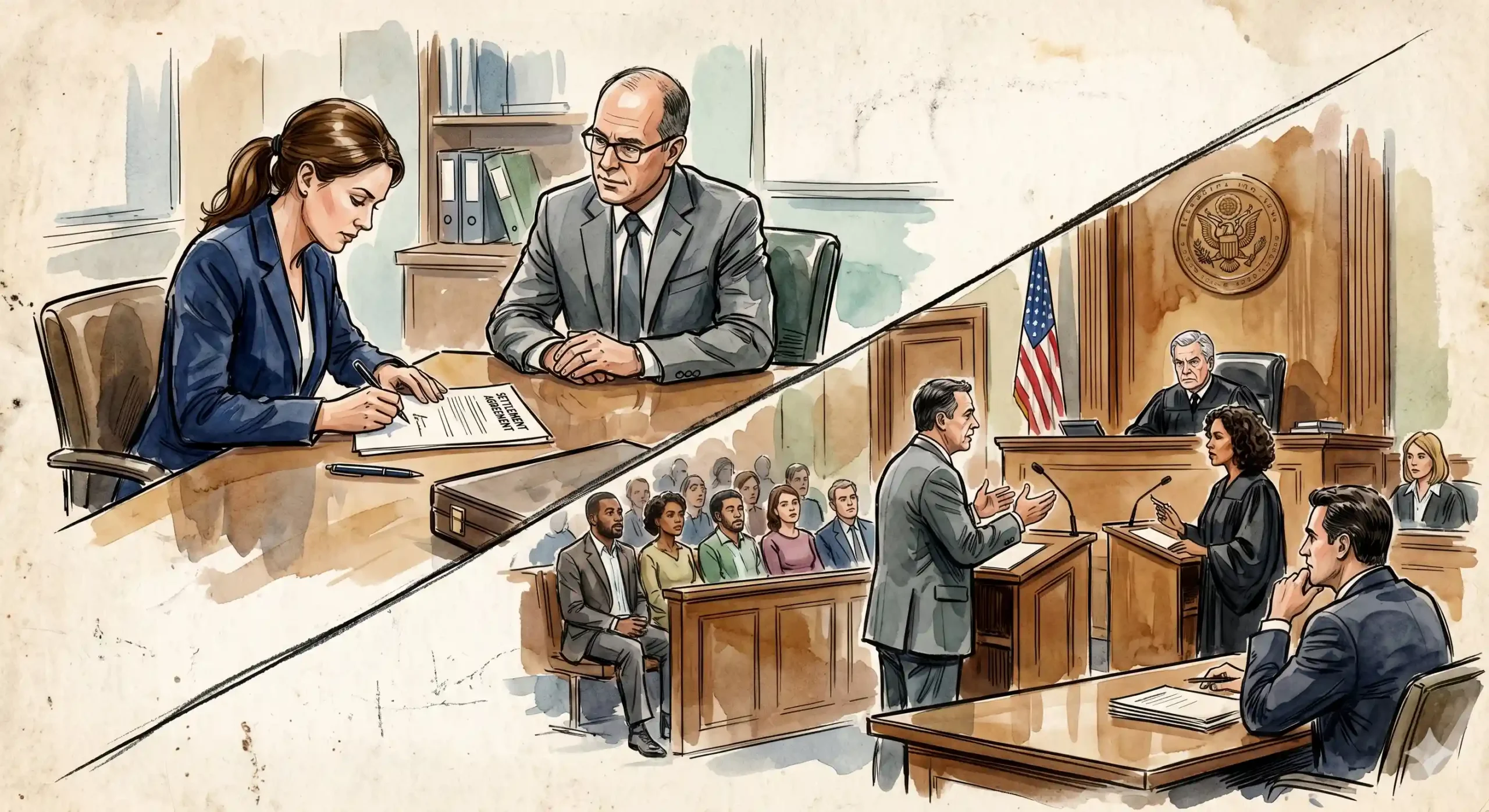
The Real Difference Between a Trial Lawyer and a Settlement Lawyer
A trial lawyer prepares every case for the courtroom and has the track record to prove it. A settlement lawyer negotiates deals and rarely, if ever, appears before a jury. The difference determines how much you recover. Insurance companies know who will try a case and who will not. They price their offers accordingly.
When people are hurt, they look for a personal injury lawyer. They assume the lawyer they hire will fight for them. They assume that if the insurance company does not offer enough, the lawyer will take it to trial.
That assumption is often wrong.
The difference between a trial lawyer and a settlement lawyer is the most important distinction in personal injury law that no one explains to injured people until it is too late. This article explains it plainly.
This article is for general information only. It is not legal advice. Laws change. Every case is different. Call us to discuss your specific situation.
Table of Contents
Why This Distinction Matters More Than Most People Realize
Insurance companies are sophisticated businesses. They track which law firms take cases to trial and which ones do not. They know your lawyer’s history better than you do.
When a settlement lawyer sends a demand letter, the insurance company knows what it means. It means the firm wants a number they can both agree on. The insurance company offers less because there is no real threat behind the demand.
When a trial lawyer sends a demand letter, the calculation changes. The insurance company knows this lawyer has tried cases. They know this lawyer has won. They know that if the case goes to trial, a jury will hear the evidence and return a verdict. That risk is real. And that risk costs money.
The threat of trial is not a bluff when the lawyer has actually tried cases. Insurance companies know the difference. Your recovery depends on which kind of lawyer you have.
What Is a Settlement Lawyer?
A settlement lawyer, sometimes called a mill attorney or a volume firm attorney, operates on a high-volume business model.
They take a large number of cases. Their revenue depends on moving cases quickly and collecting fees on as many as possible. The faster a case closes, the sooner the fee comes in and the next case can start.
Most settlement lawyers are not bad people. Some are genuinely talented at negotiation. But their business model creates a structural incentive that does not always align with their clients’ best interests.
When the insurance company offers a number, the settlement lawyer’s first question is often “is this close enough?” not “is this what the case is worth?” Going to trial takes months or years. It costs money the firm has to front. It creates uncertainty. It delays the fee.
Settling is almost always better for the firm’s cash flow. Trial is almost always better for the client’s recovery, when the case has genuine value.
The volume model is not just a business choice. It shapes how these firms prepare cases. When you do not expect to go to trial, you do not invest in the preparation trial requires: expert witnesses, extensive depositions, thorough investigation, engineering analysis, economic projections. You gather enough to negotiate. You do not gather enough to win a verdict.
What Is a Trial Lawyer?
A trial lawyer prepares every case as if it will go to a jury. Even when they expect to settle, the preparation is trial-ready. That preparation is what gives the demand meaning.
Trial lawyers take fewer cases. They have to, because each case demands more time, more resources, and more depth of preparation. A firm that tries cases regularly cannot run on volume. The business model simply does not allow it.
This model creates a different kind of alignment with the client. The trial lawyer’s reputation depends on results. Their referral base depends on outcomes. A bad trial result is visible. A bad settlement is invisible. The incentive structure tilts toward actually winning, not just closing.
Trial lawyers hire experts early. They investigate thoroughly. They identify every responsible party. They document damages completely. They take depositions of witnesses and corporate representatives. They prepare to put witnesses on the stand and ask hard questions in front of a jury.
When they send a demand, it is backed by preparation that any defense attorney or insurance company adjuster can recognize.
How Insurance Companies Respond Differently to Each
This is the most concrete part of the answer. Insurance companies pay more when they believe a lawyer will try the case.
Here is why. When a case goes to trial, the insurance company loses control of the outcome. A jury decides. Juries in Georgia have returned verdicts in the millions of dollars for cases involving serious injury and wrongful death. The risk of a large verdict is real.
Insurance companies build their reserves, the money they set aside for claims, based on their assessment of risk. When a trial lawyer is on the case, the risk of a large verdict is higher. That raises the reserve. That raises what they are willing to pay to settle.
When a settlement lawyer is on the case, the insurance company’s experienced defense team knows that if they hold firm, the case will likely settle. They offer less. They hold longer. They know the other side does not want to go to trial.
It is not personal. It is math. And it is math that directly affects what you recover.
The Numbers: What the Difference Actually Costs You
McDonald & Cody has documented side-by-side comparisons from their own case history. These are real cases. Real offers. Real verdicts.
A teenager’s death. The insurance company offered $1.8 million. The firm took it to trial. The jury awarded $4.3 million.
A medical malpractice case. The offer was $1.4 million. Trial result: $2.2 million.
A permanent injury case involving surgery. The offer was $1 million. Trial result: $3.2 million.
An automobile collision. The offer was $1.5 million. Trial result: $4 million.
These are not cherry-picked outliers. These are documented examples of the trial premium. The difference between what insurance companies offer and what juries award when a prepared trial lawyer presents the evidence is two to four times the settlement number.
That gap is real. And it belongs to the client.
How to Tell the Difference Before You Hire
Most law firms market themselves as trial lawyers. Very few of them actually try cases with any regularity. Here is how to find out the truth.
Ask how many jury trials they have completed. Not how many they have filed. How many they have taken all the way to a verdict. A firm with 400 jury trials over 50 years has a different relationship with the courtroom than one that settled its last 50 cases in a row.
Ask for their trial results. Not just the big ones on their website. Ask what happened in cases like yours.
Ask what percentage of their cases go to trial. This question often produces an honest answer. For many volume firms, it is under 1%.
Ask whether they will personally try your case. At some firms, the lawyer you meet with is not the one who handles the case. Your case goes to a junior associate or, in some models, a case manager.
Ask about their resources. Preparing a serious case for trial costs money. Expert witnesses, depositions, engineering analysis, and investigation all have real costs. A firm without the financial resources to fund those costs will be pressured to settle before those expenses pile up.
What Questions to Ask Before You Hire Any Personal Injury Lawyer
Before you sign anything, ask these directly:
How many jury trials have you personally conducted? What percentage of your cases go to trial? Who will actually handle my case day to day? Will I speak to an attorney or a case manager? Do you have the resources to take my case to trial if needed? Have you tried cases against defendants like mine?
The answers will tell you everything you need to know about what kind of firm you are dealing with.
Frequently Asked Questions
What is the difference between a trial lawyer and a settlement lawyer?
A trial lawyer prepares every case for the courtroom and has a documented history of jury trials and verdicts. A settlement lawyer negotiates with insurance companies and rarely, if ever, takes cases to trial. Insurance companies pay more when they believe a lawyer will actually try the case.
Do I need a trial lawyer for my personal injury case?
If your injuries are serious or permanent, if a corporation or institution is on the other side, or if you have been offered a quick settlement, you need a lawyer who can credibly threaten and execute a trial. A settlement lawyer in those circumstances leaves money on the table.
How do I know if my lawyer will actually try my case?
Ask directly how many jury trials they have completed and what percentage of their cases go to trial. Ask for documented results. Ask who will work on your case.
Every case is unique. Call us to discuss your situation.